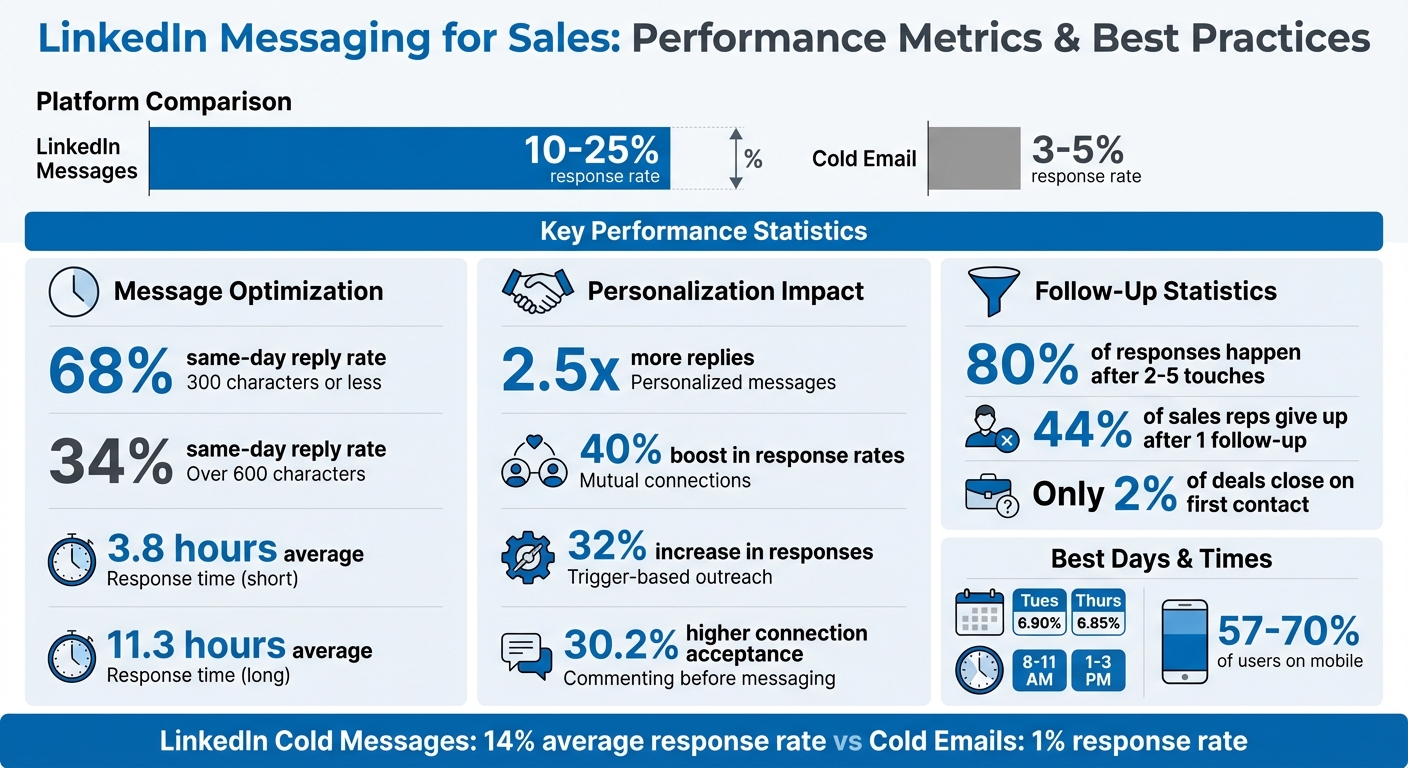
LinkedIn messaging is a powerful tool for B2B sales, outperforming cold emails with response rates of 10%–25% compared to just 3%–5%. Why? LinkedIn offers context and credibility – prospects can see your profile, role, and activity, making your outreach feel more relevant. But to succeed, you need to avoid generic pitches and focus on personalization, timing, and value-first messaging.
Here’s a quick breakdown of the 10 best practices to improve your LinkedIn outreach:
- Personalize messages: Reference specific details like recent posts, job changes, or company news.
- Keep it short: Messages under 300 characters perform better, especially on mobile.
- Lead with value: Share insights, tips, or resources before pitching.
- Engage with activity: Mention their recent posts or achievements to show genuine interest.
- Use soft CTAs: Ask easy, low-pressure questions instead of pushing for a demo.
- Avoid templates: Generic messages get ignored; make each outreach unique.
- Send at the right time: Mid-week mornings or early afternoons work best.
- Follow up smartly: Space follow-ups 2–5 days apart and always add value.
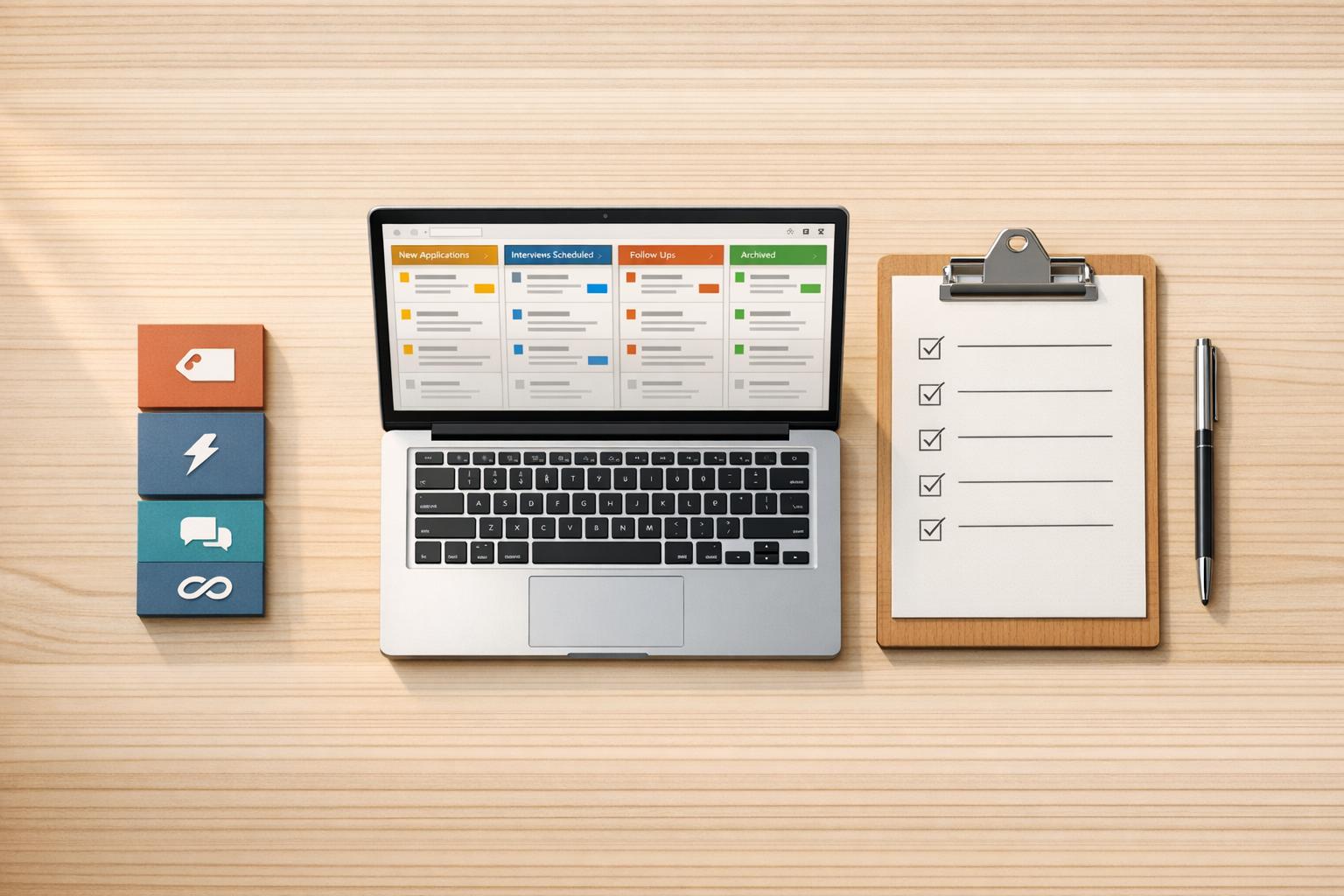
- Organize your inbox: Use tools like Cesar.chat for managing leads and follow-ups.
- Save time with tools: Automate repetitive tasks with message snippets and CRM sync.
These strategies help you stand out in crowded inboxes, build genuine connections, and increase response rates. Start small by trying a few of these tips in your next campaign and track what works.
LinkedIn Messaging vs Cold Email: Response Rates and Best Practices Statistics
1. Personalize Every Message with Specific Details
Personalization and relevance
When it comes to LinkedIn messaging for sales, personalization is the game-changer. Generic messages? They often get ignored. But when you add 1–2 specific details to your outreach, you can see up to 2.5x more replies. Why? Because relevance matters. When prospects notice you’ve taken the time to understand them, they’re much more likely to respond.
Take just two minutes to research a prospect’s profile before hitting send. Look at their "About" section, check for recent job changes or promotions, and skim their "Activity" tab for posts they’ve shared or commented on. For example, if they’ve posted about AI adoption in manufacturing or commented on a supply chain discussion, mention it. A simple nod to their interests shows you’ve done your homework. And don’t stop there – tie in shared connections or recent events to make your message even more impactful.
"Personalization isn’t optional – it’s essential. Generic ‘I’d love to connect’ notes get ignored, while tailored messages stand out and drive real engagement."
- Zivko D., CEO, DoneMaker
Shared context and timely triggers can take your outreach to the next level. Did you notice a mutual connection? That alone can boost response rates by 40%. Maybe you went to the same college or belong to the same LinkedIn group – mention it to build rapport. Also, keep an eye out for company news, like funding rounds, product launches, or new hires. Referencing these events shows you’re tuned in to their world, not just sending out a cookie-cutter pitch.
Here’s a small but meaningful tweak: use the prospect’s name naturally within the message instead of just at the start. For example, instead of saying, "Hi Sarah, I noticed your company just raised Series B", try, "Noticed your team at Acme Corp just raised Series B, Sarah – congrats on the momentum." It feels more like a conversation and less like a script.
sbb-itb-3e8f5dc
2. Keep Messages Under 300 Characters
Message Length and Clarity
Short messages aren’t just polite – they’re effective. With over 70% of LinkedIn users accessing the platform on mobile devices, concise messages are easier to read and more likely to grab attention. Research backs this up: messages under 300 characters are read more often and get faster replies. On average, these shorter messages receive responses in just 3.8 hours, while longer ones (over 600 characters) take more than 11.3 hours. Even more striking, 68% of short messages get a same-day reply, compared to only 34% of longer ones.
If brevity isn’t your natural style, don’t worry – your first draft is just the beginning. Most initial messages are 40-50% too long. Start writing naturally, then edit ruthlessly. Cut out filler phrases like "I hope this finds you well" or "My name is…" and dive straight into your personalized hook. A good structure to follow includes:
- Personalized hook (40-60 characters)
- Brief challenge (60-80 characters)
- Proof point (80-100 characters)
- Clear call to action (30-40 characters).
This approach isn’t just theory. In 2026, Built.io expanded its SDR team from 25 to 85 members by sticking to messages under 300-400 characters. By addressing specific scaling challenges and keeping their outreach concise, they boosted response rates from 12% to 18% and secured over 300 additional qualified meetings per quarter.
"Concise, well-written messages show you’ve put thought into your outreach and respect the recipient’s time. For sales professionals targeting C-level executives, this kind of precision signals professionalism and strategic thinking."
The numbers and insights make it clear: keeping it short isn’t just courteous – it’s smart.
3. Offer Value Before Making Your Pitch
Personalization and Relevance
When reaching out to prospects, it’s crucial to lead with value instead of diving straight into a sales pitch. Nobody enjoys being sold to immediately – it often leads to disengagement. Instead, start by offering something genuinely helpful, like a relevant article, an industry insight, or a practical tip, without expecting anything in return. This approach helps establish trust and builds a connection long before you ask for a meeting.
Giving value upfront often triggers reciprocity. For example, in February 2026, Anton Titov, Founder at Archway.Finance, reached out to 400 agency owners with personalized, non-salesy messages. This approach resulted in a 65% response rate and contributed to raising over $1M in funding. Additionally, 57% of buyers are more likely to engage when messages focus on solving specific challenges rather than pushing a product.
To make your outreach stand out, research your prospect thoroughly. Look into their recent posts, company updates, or funding news to identify potential challenges or opportunities. Then, craft your message around something specific. For instance, instead of using a generic line like "We help companies like yours", you could say: "I saw your team recently expanded into the Northeast. Here’s a quick 2-slide summary of how three other companies successfully scaled regionally while staying within budget." This level of detail shows you’ve done your homework and positions you as a knowledgeable peer rather than just another salesperson.
End your message with a low-pressure question, such as "How are you approaching [specific challenge]?" to encourage a conversation without putting the prospect on the defensive. Alternatively, asking for their feedback can position them as an expert and invite engagement. With 50% of B2B buyers using LinkedIn for purchase decisions, establishing yourself as a helpful resource from the beginning can set you apart in a crowded marketplace.
4. Reference Recent Prospect Activity
Personalization and Relevance
Bringing up a prospect’s recent activity is a quick way to show you’ve done your homework. But skip the vague compliments like "Great post." Instead, dive into specifics. For example, if someone shared their thoughts on managing remote teams, you could say: "Your point about async communication in distributed teams really hit home, especially the part about documentation culture." Messages that reference job changes, shared content, or company updates have been shown to increase reply rates by 27%.
Trigger events are another goldmine for personalization. Promotions, new hires, or funding announcements are perfect touchpoints. Paulina Gębczyk, Marketing Lead at CrustLab, shares her strategy:
"I usually start by pulling one thing from what they’re actually doing – maybe they hired someone new, or they published something that signals a change. That’s my hook." – Paulina Gębczyk, Marketing Lead at CrustLab
This approach works – outreach tied to these specific moments can boost response rates by 32%.
Timing and Engagement Strategies
Timing matters as much as the message itself. A simple "Like → Comment → Message" sequence can help establish goodwill before you even reach out. In fact, commenting on a prospect’s post a day or two before messaging them can increase connection acceptance rates by 30.2%. And don’t overlook your opening line – over 40% of users decide whether to open a message based on the first sentence alone. Starting with a direct reference to their recent activity makes all the difference.
To keep your outreach relevant, aim to send your message within 24–48 hours of the trigger event. Whether it’s a new role announcement or a funding milestone, acting quickly ensures your message feels timely and considerate. Andrew Franks, Co-Founder at Reclaim247, sums it up well:
"Contextual short messages always receive the best responses. A reference to a specific recent post or achievement by a prospect always works. It makes the rep seem like a human being." – Andrew Franks, Co-Founder at Reclaim247
How to Use LinkedIn Messages for More Qualified Leads and Sales
5. Use Soft Calls to Action
After honing personalization and keeping things concise, soft calls to action (CTAs) are the final piece of the puzzle for starting engaging, low-pressure conversations.
Message Length and Clarity
Hard CTAs like "Book a 30-minute demo" can often put people off, triggering resistance. Soft CTAs, on the other hand, feel more conversational and less pushy. Instead of jumping straight to a meeting request, you can invite an easy, low-commitment response – like answering a quick question, sharing an opinion, or simply replying with a "yes" to receive a resource.
Short messages (under 400 characters) that include soft CTAs have been shown to increase response rates by 22%. Keeping the CTA itself to about 30–40 characters ensures it displays fully in mobile previews. For instance, asking something like "Mind if I ask you a quick question?" or "Would you be open to a quick chat?" reduces pressure and makes it easier for the recipient to say yes.
Pairing brevity with a personal touch makes your outreach even more effective.
Personalization and Relevance
The best soft CTAs position your prospect as an expert. Instead of diving into a sales pitch, ask for their thoughts on an industry trend or a specific project. For example, you might say, "Could I get your brief feedback on a project we’re working on to help teams reduce onboarding time?" This taps into their natural desire to help and piques curiosity – without triggering the usual sales defenses.
Another effective tactic is the "Right Person" approach, where you acknowledge uncertainty. For example: "Not sure if you’re the right person – could you point me in the right direction?" This lowers pressure and increases the likelihood of a response.
LinkedIn power user tips and follow-up techniques
Soft CTAs can also shine in follow-up efforts, helping to nurture conversations over time.
In 2025, Tim Scheuer, Co-Founder of Prospera AI, tested a soft CTA asking prospects to "just send me a 👍" to receive a guide on sales AI agents. Out of 184 messages, this simple approach generated a 45% reply rate and resulted in 5 booked meetings. Similarly, Tim Yakubson, Founder of B2B Boosted, used a "reply ‘yes’" CTA to share a lead magnet. His campaign, which targeted 1,051 leads, achieved a 45% connection acceptance rate and a 26% reply rate.
Soft CTAs are also invaluable in long-term follow-ups. Since 80% of LinkedIn responses happen after 2–5 touches, gentle nudges like "Should I circle back next week?" keep the conversation alive without feeling intrusive. And with LinkedIn cold messages averaging a 14% response rate – significantly higher than the 1% typically seen with cold emails – this approach gives your outreach a noticeable advantage.
6. Avoid Generic Templates and Spam Language
If you want your outreach to resonate, steer clear of generic templates and language that screams spam. Personalization and clarity are your best allies.
Personalization and Relevance
Relying on cookie-cutter, template-heavy messages can backfire. They often come across as impersonal and self-serving, which is a quick way to lose a prospect’s interest. Decision-makers can spot these a mile away – messages with placeholders like "[Company Name]" or "[First Name]" are often ignored within seconds.
Even worse, LinkedIn’s AI now flags mass templated messages, pushing them into the dreaded "Other" tab. The numbers don’t lie: response rates for cold templates have plummeted from 15–20% in 2020 to just 5–10% in 2026. In contrast, inbound conversations have a conversion rate of 14.6%, compared to a mere 1.7% for templated outreach. The takeaway? Personalized messages that feel genuine and relevant perform far better.
Message Length and Clarity
Personalization is just the start – how you structure your message is just as important. Keep it clear, concise, and free from spammy language.
Certain phrases – like "Hi, I saw your profile", "Hope this finds you well", or "Just touching base" – are red flags for both recipients and spam filters. Similarly, overused corporate jargon such as "discuss potential synergies" or "exciting opportunity" makes your message sound automated and unoriginal.
Length also matters. Long, wordy messages are often skipped because they seem like too much effort to read. Messages under 400 characters perform 22% better than average, while those over 1,200 characters perform 11% worse. Aim to keep your message under 100 words, break it into short paragraphs for easy reading on mobile devices, and avoid including external links in your initial outreach. Links can trigger spam filters or make your message look promotional.
Efficiency Tools and Follow-Up Techniques
To avoid sounding repetitive, tools like Spintax can help you randomize greetings, openings, and calls to action. This ensures each message feels unique, even if you’re reaching out to multiple people.
For the best results, go a step further and reference something specific about the recipient. Mention a recent post they shared, a company milestone, or a mutual connection. This kind of tailored outreach performs 10× better than generic pitches. It shows you’ve done your homework and genuinely care about starting a meaningful conversation.
7. Send Messages at the Right Time
Timing and Engagement Strategies
When it comes to LinkedIn outreach, timing can make or break your message. Even the most carefully crafted note can go unnoticed if it lands at the wrong moment. To boost your chances of a response, aim to send messages when your prospect is most likely to see and act on them.
Mid-week is your sweet spot. Research shows that Tuesday, Wednesday, and Thursday are the best days for outreach. For example, Tuesday boasts a reply rate of 6.90%, with Thursday close behind at 6.85%. On the flip side, weekends tend to be less effective, with reply rates ranging from 2.6% to 6.4%.
Timing during the day matters, too. Peak times for engagement are typically between 8:00–11:00 AM and 1:00–3:00 PM. Additionally, with 57% of LinkedIn users accessing the platform via mobile devices, targeting commute times (like 5:00–6:00 PM) can also yield good results.
Don’t forget time zones. If you’re sending a message from New York at 9:00 AM, it’s only 6:00 AM in Los Angeles – hardly ideal for catching someone’s attention. Use scheduling tools to ensure your message aligns with the recipient’s local time and activity patterns. As Saurav Gupta, Founder of SalesRobot, puts it:
"Timing your outreach helps increase the chances of your message being seen and acted upon. Sending your message at the right moment is the only way to make sure it doesn’t get buried in a crowded inbox."
Follow-up strategy matters. Plan your follow-ups carefully to avoid overwhelming your prospect. Wait 2–5 days after your initial message before sending a follow-up, and then space subsequent messages 7–10 days apart. If you’re reaching out on a Monday, hold off until after 10:00 AM to increase your chances of success.
Mastering the timing of your outreach can amplify the effectiveness of the personalized messaging techniques discussed earlier.
8. Plan Your Follow-Up Sequence
Following up effectively is just as important as the initial outreach. A well-thought-out sequence can significantly improve your chances of getting a response.
Timing and Engagement Strategies
Did you know that 44% of sales professionals give up after just one follow-up, even though only 2% of deals are closed on the first contact?. This highlights the importance of persistence – but with a plan.
A good rule of thumb is to follow a 14-day schedule: send follow-ups on Days 1, 4, 9, and 14. Also, give it 24–48 hours after your connection request is accepted before reaching out. This avoids coming across as overly automated or pushy. Showing patience and respect for their time can go a long way in building rapport.
But timing isn’t everything – your follow-up messages need to offer value, too.
Personalization and Relevance
Avoid the standard "just checking in" messages – they rarely get a response. Instead, make each follow-up count by adding value. This could mean sharing a case study that aligns with their industry, referencing a recent company milestone, or commenting on a post they shared. As Laura Hannah, Founder of Pitch121, puts it:
"LinkedIn’s inbox functionality is quite basic, which makes it easy for messages to get buried. Similar to email forwarding, a follow-up message effectively brings your original message back to the top of the recipient’s inbox."
For later follow-ups, use simple yes-or-no calls to action (CTAs), like: "Would you prefer a quick 10-minute call, or should I send over a case study first?". This approach shows you’re serious about tailoring the conversation to their needs.
Personalization is essential, but so is keeping your message clear and concise.
Message Length and Clarity
When it comes to LinkedIn follow-ups, less is more. Stick to 300 characters or fewer – ideally under 50 words – for the best response rates. For your final follow-up on Day 14, consider a polite and low-pressure close, such as: "I know you’re busy, so I’ll stop reaching out. Feel free to contact me if things change." This kind of message can often reignite stalled conversations.
If you’ve sent 3–4 follow-ups without a response, it’s time to move on. Respecting their time shows professionalism and leaves the door open for future opportunities.
9. Organize Your Inbox with Cesar.chat Split Inboxes
Efficiency Tools and Follow-Up Techniques
Managing multiple LinkedIn conversations can feel like juggling too many balls at once. Without a proper system, important messages often get buried, and high-value prospects slip through the cracks. This is a big deal, especially when you consider that 48% of sales reps never follow up, even though 80% of successful responses happen after 2–5 touches. Staying organized isn’t just helpful – it’s essential for closing deals.
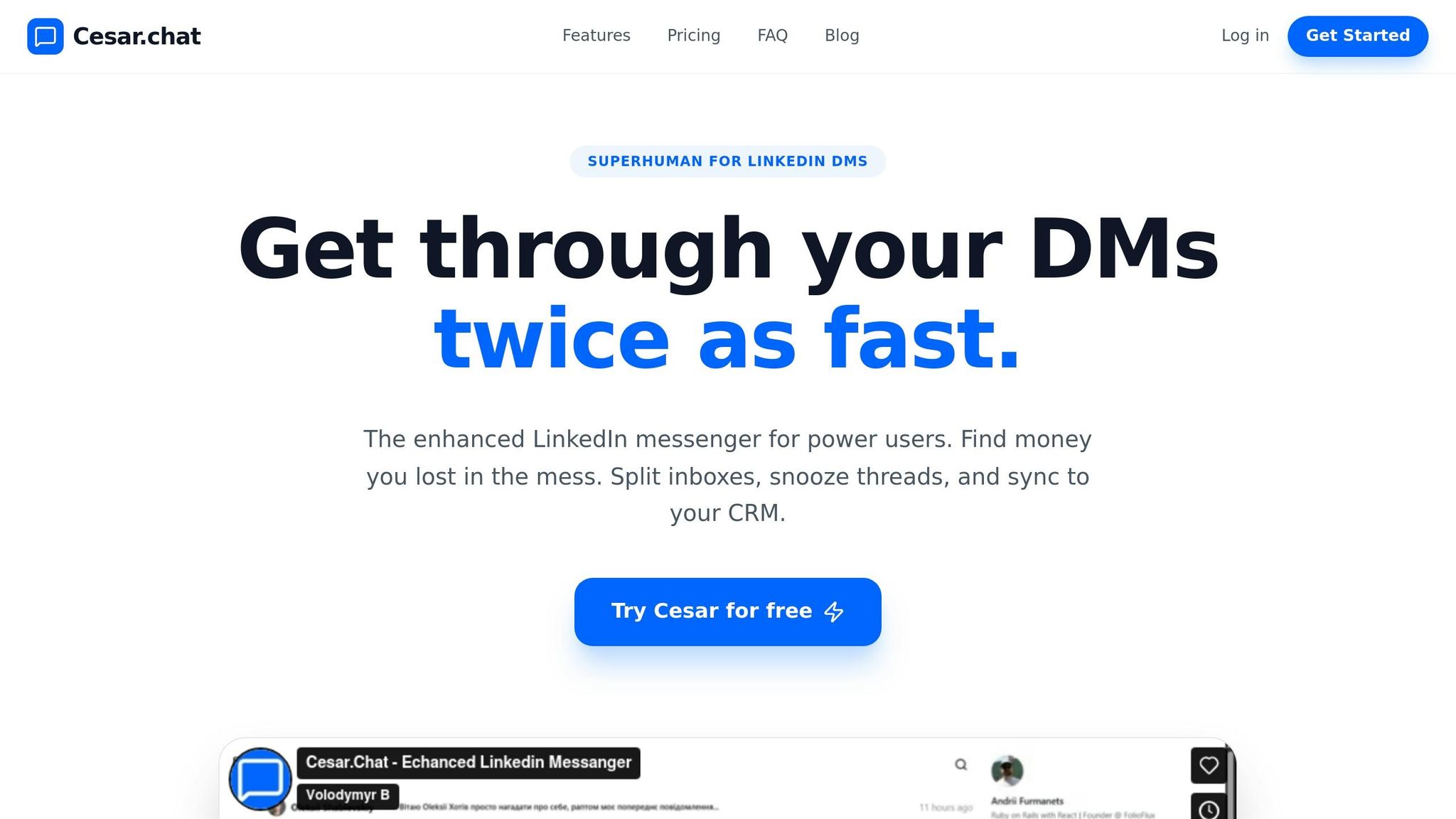
Cesar.chat tackles this problem head-on with its Split Inboxes feature. It lets you label and categorize conversations into dedicated inboxes. Imagine having separate spaces for "Hot Leads", "Awaiting Response", or "Partnerships." This way, your priority prospects stay front and center, not lost in a sea of messages. Plus, the Snooze feature is a game-changer – it temporarily hides threads and brings them back to the top of your inbox exactly when you need to follow up.
"Find money you lost in the mess. Split inboxes, snooze threads, and sync to your CRM." – Cesar.chat
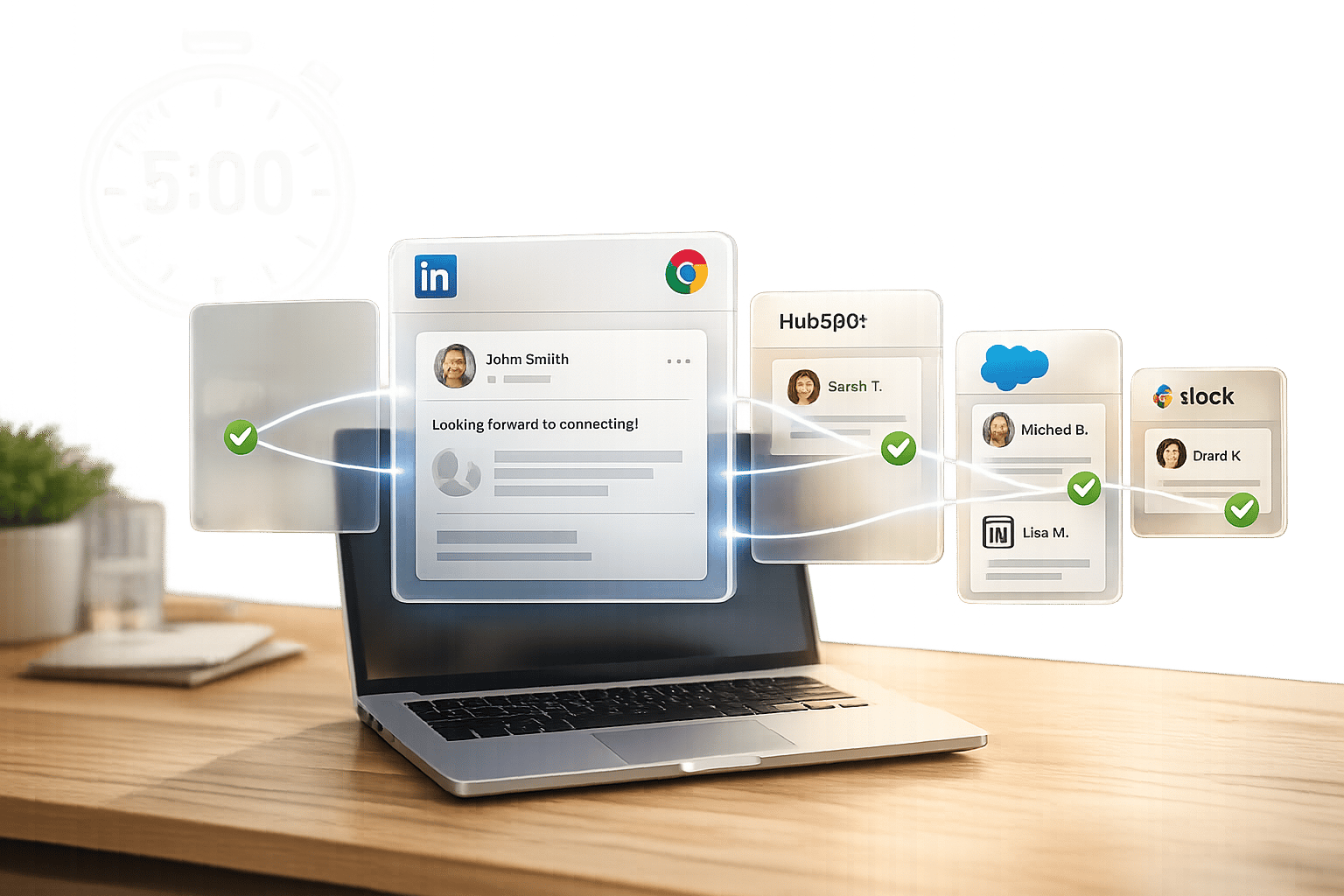
But it doesn’t stop there. Cesar.chat also offers keyboard shortcuts for faster navigation, Snippets for quick and polished replies, and seamless CRM integration. Whether you use HubSpot, Salesforce, Notion, or Clay, the platform syncs conversation data, labels, and notes automatically, giving you a complete view of your prospects without extra effort. This means you can focus more on meaningful follow-ups and less on manual tracking.
For sales teams looking to master LinkedIn outreach, these tools turn inbox chaos into a well-oiled system, making it easier to prioritize conversations that lead to conversions.
10. Save Time with Cesar.chat Snippets and CRM Sync
Efficiency Tools and Follow-Up Techniques
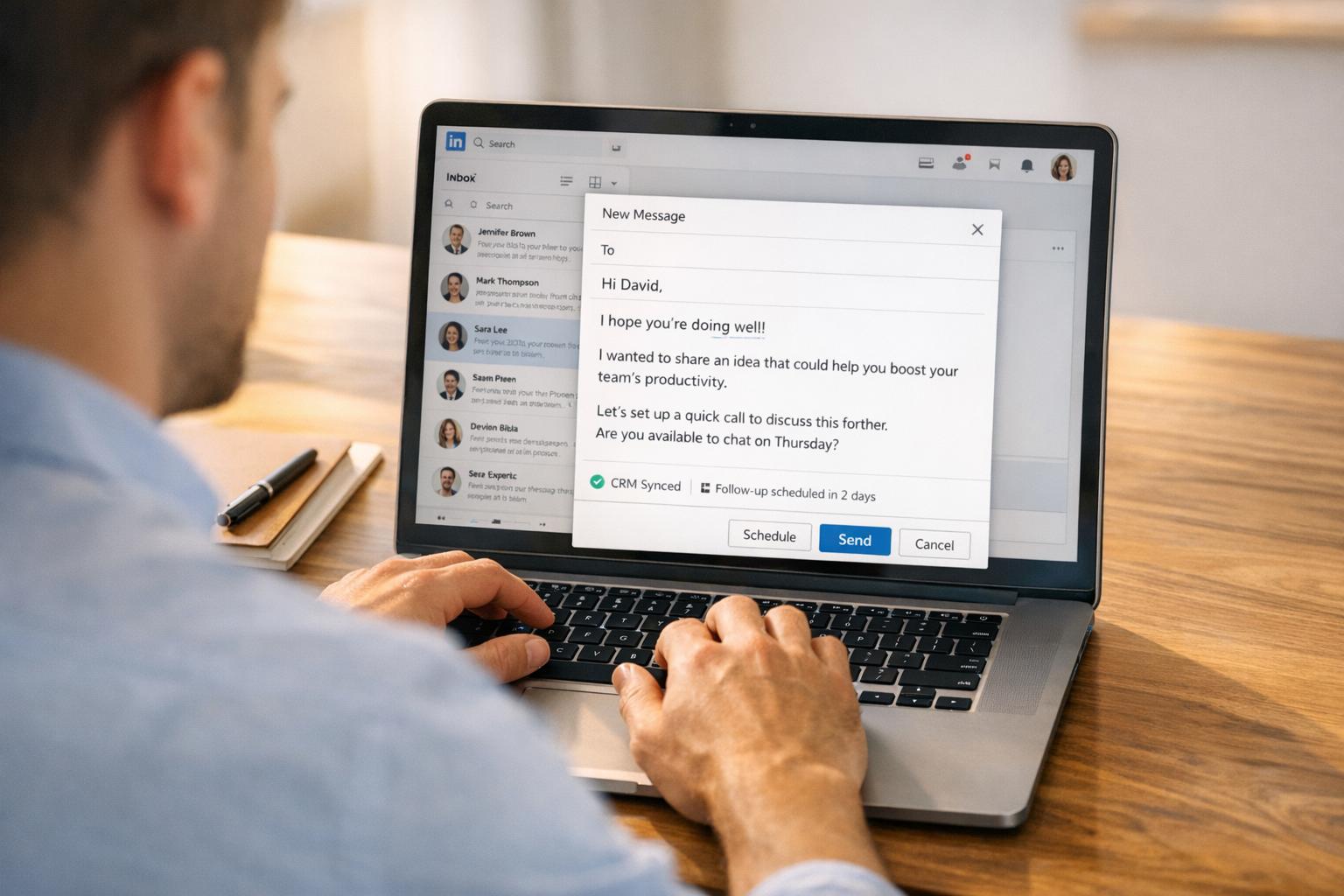
Typing out LinkedIn messages over and over can eat up a lot of time. For sales reps, this means hours lost on manual outreach instead of closing deals. That’s where Snippets step in. These are high-performing message templates that you can quickly tweak with specific details about your prospect. Think of them as your go-to messages, ready to fire off with minimal effort. Combine these templates with a seamless CRM sync, and your sales process becomes much more efficient.
Cesar.chat takes it further by automatically logging every LinkedIn interaction – whether it’s connection requests, message replies, or other activities – straight into CRMs like HubSpot, Salesforce, and Pipedrive. This creates a complete view of each prospect’s journey across all touchpoints. Say goodbye to manual data entry and the risk of missing important follow-ups.
"All LinkedIn activities and interactions are automatically logged and synced with CRMs like HubSpot, Salesforce, Pipedrive, and more. You can skip manual data entry and get a unified view of the sales pipeline." – Crono
When you open a prospect’s profile, you’ll see everything in one place – email history, phone calls, and LinkedIn messages. This ensures your team has full visibility into every interaction, avoiding awkward overlaps where multiple reps contact the same person. On top of that, managers can analyze which message templates are driving results, helping you focus on what’s actually working.
Conclusion
To make your LinkedIn messaging stand out, focus on personalization, smart timing, and leveraging the right tools. While LinkedIn messaging may seem straightforward, the difference between being ignored and starting a meaningful conversation lies in these key strategies.
Skip the generic templates. Instead, reference a recent post, a shared challenge, or a mutual connection to make your outreach feel tailored. Keep your messages short – under 300 characters – so they’re easy to read, especially on mobile. Timing matters too: aim to send messages between Tuesday and Thursday, from 9–11 am or 1–3 pm in the recipient’s timezone for the best chance of a response. And don’t stop after the first message – 80% of responses come after 2–5 follow-ups.
By combining these tactics, your LinkedIn outreach can be both strategic and effective. Tools like Cesar.chat help streamline the process by organizing your inbox, saving time with pre-written snippets, and syncing conversations to your CRM. This lets you focus on building relationships instead of getting bogged down in administrative work. When you pair personalized outreach with consistent follow-ups and CRM integration, you create a scalable system that delivers results.
Start small – try implementing just two or three of these practices in your next campaign. Track your progress, analyze the data, and refine your approach. The prospects you want to connect with are already on LinkedIn, and now you have a clear roadmap to reach them and improve your success rate.
FAQs
What should my first LinkedIn message say?
Your first LinkedIn message needs to feel personal and provide something worthwhile to grab attention. Mention something specific about the recipient, like a recent post or an achievement you noticed on their profile. Then, highlight how connecting could benefit them. Keep it short – under 100 words – and aim to send it during their business hours to increase the likelihood of a reply.
Example:
"Hi [Name], I came across your post on [topic] and found it insightful. I’d love to connect and share some resources that might align with your goals in [specific area]."
How many follow-ups is too many on LinkedIn?
Research shows that following up with prospects up to four times within a 14-day window tends to be effective. Pushing beyond four follow-ups can backfire, potentially irritating your audience and lowering engagement levels. The key lies in balancing quality and timing to boost response rates without overwhelming your prospects.
When should I stop trying to connect or message?
When your messages are being ignored repeatedly or fail to make an impact, it’s time to step back. If you’ve made several attempts – carefully timed and personalized – and still receive no response, continuing to reach out could come across as unprofessional or even spammy. Knowing when to pause your outreach isn’t just a matter of courtesy; it helps protect your reputation and ensures your communication remains thoughtful and intentional.